How to Evaluate Blanket Quality: GSM, Pile and Finish Explained
Published 7 May 2026 · Updated 8 May 2026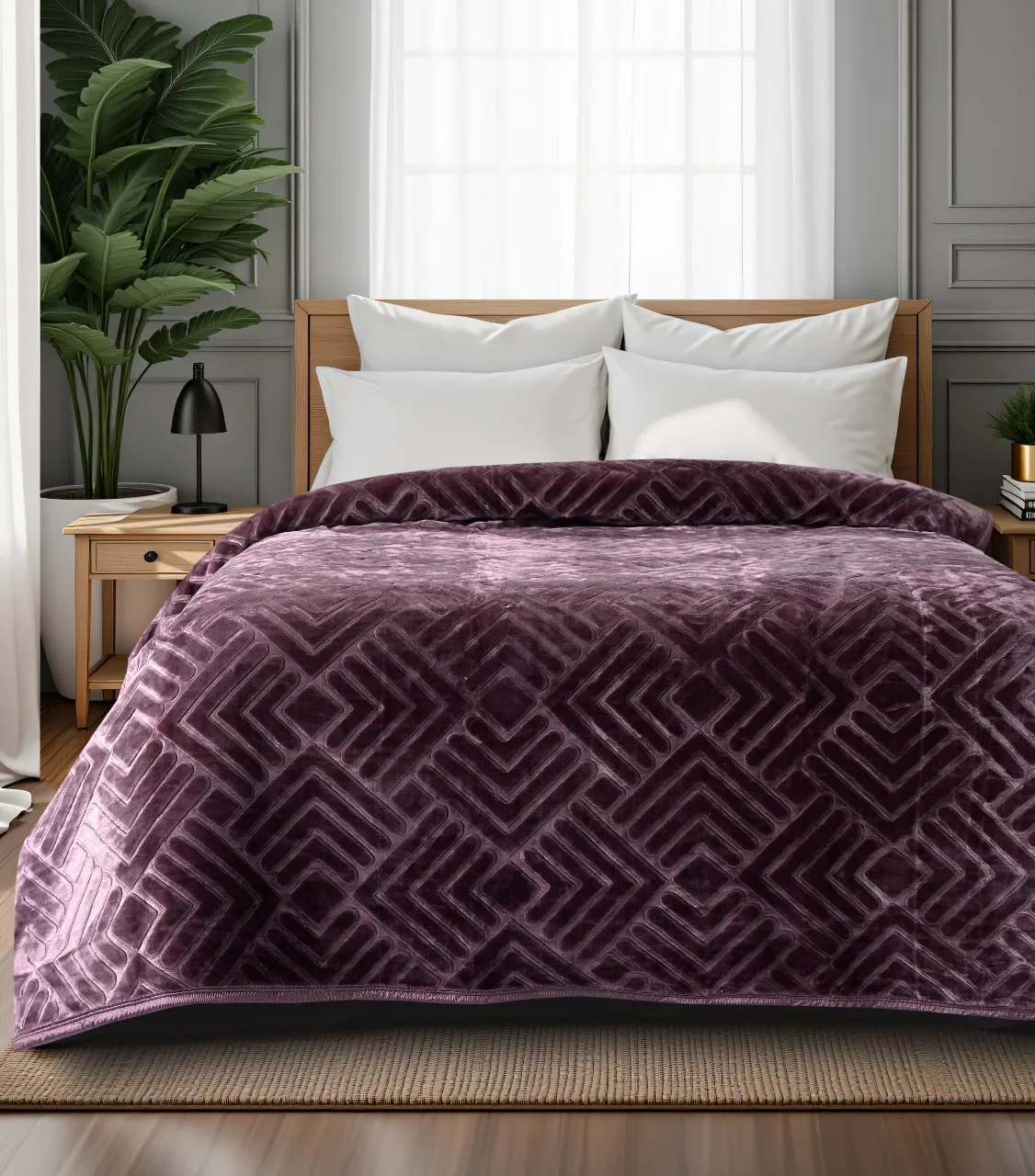
Without a working vocabulary for blanket quality, buyers are at the mercy of marketing copy. "Premium." "Luxurious." "Ultra-soft." These words appear in every catalogue and tell a buyer almost nothing. The buyers who consistently negotiate well, sample efficiently, and avoid complaint-heavy SKUs share one habit — they have a technical baseline. This guide gives you that baseline. It covers GSM, pile construction, finishing, the standard quality tests, and a practical sample-evaluation protocol you can run in fifteen minutes.
GSM — What It Actually Measures
GSM stands for grams per square metre. It is the weight of one square metre of the blanket fabric. Higher GSM generally means more material per unit area, which usually correlates with warmth, drape, and perceived premium-ness.
Typical ranges by tier:
- Light (200–300 GSM): Throws, summer-weight layering pieces, lightweight bed coverings.
- Mid (400–700 GSM): All-season blankets, value-tier mink and embossed constructions.
- Heavy (800–1100 GSM): Winter blankets for cooler climates, the bulk of mid-market retail volume.
- Premium (1200+ GSM): Heavy mink, hospitality-grade pieces, gifting-tier products.
What GSM does not tell you is equally important. A 1000 GSM blanket made with poorly recovered pile will feel inferior to an 800 GSM blanket with dense, well-recovered pile. GSM is necessary but not sufficient. It indicates raw material commitment, not quality of construction.
Pile Construction — Length, Density, Recovery
Pile is the raised surface of the blanket — the soft side. Three properties define pile quality.
Length is the visible height of the pile fibres. Longer pile reads as plush at first touch but tends to flatten faster with use and washing. Density is how tightly packed the fibres are per square inch. Density is what creates the substantial, full-handed feel that consumers associate with premium products. Recovery is the pile's ability to spring back after compression.
The single most useful field test is the pinch test for recovery. Pinch a section of the pile firmly between thumb and forefinger for ten seconds, release, and count how long the depression takes to fill back in. Premium constructions recover within two to three seconds. Poor constructions show a visible flat patch for thirty seconds or longer.
Common pile types include mink (longer, denser, premium hand-feel), fleece (shorter, lighter, value-tier), sherpa (curled fibres mimicking shearling, often used as a backing), and embossed pile (sculpted with heat and pressure to form patterns). Each has a distinct use case and a distinct cost profile.
Finishing Techniques
Finishing is what transforms raw fabric into a marketable blanket. The technique stack is meaningful — it directly affects perceived quality and unit cost.
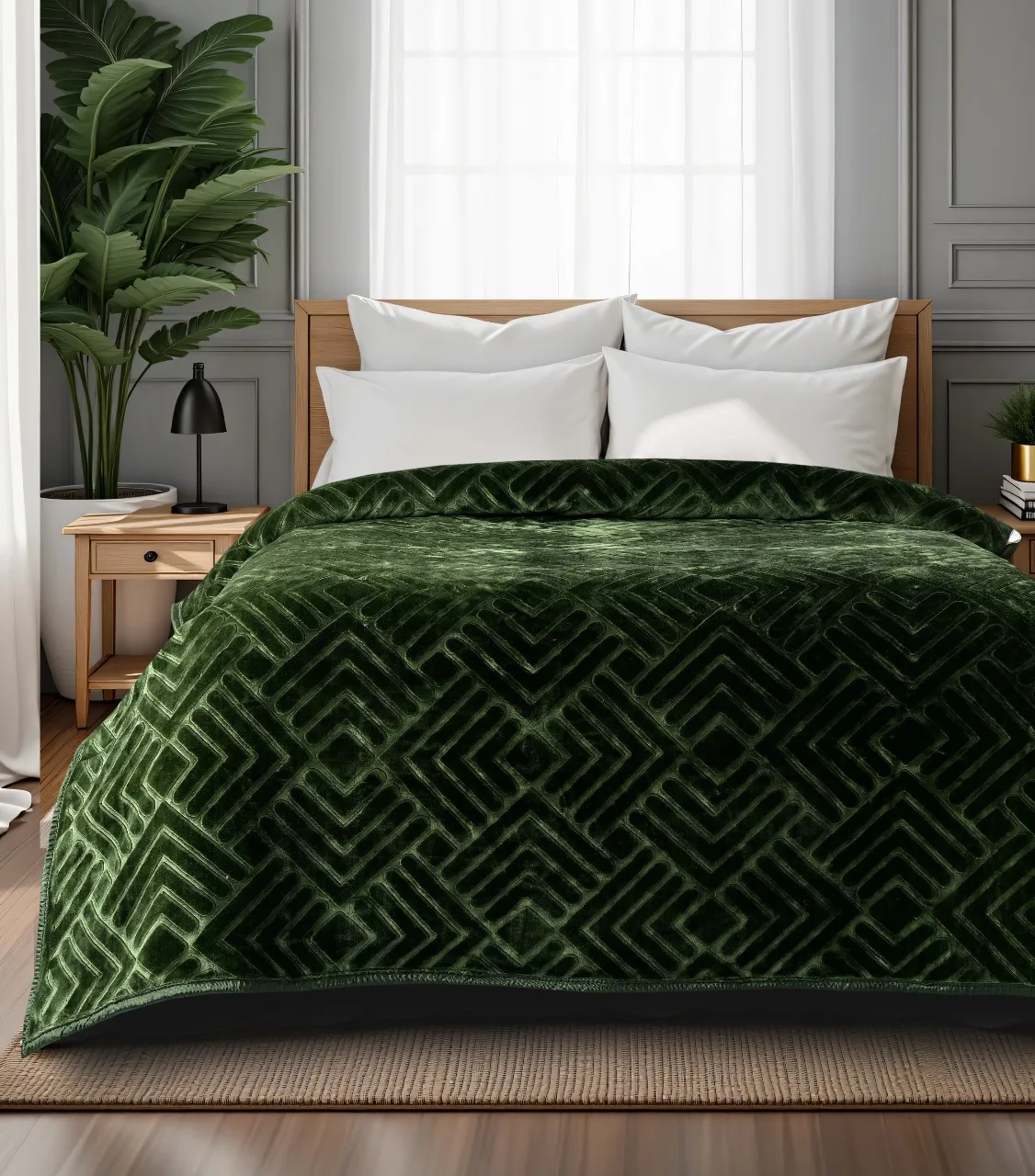
Embossing uses heated rollers to press patterns into the pile. It adds visual depth, texture, and design differentiation. Satin border is a contrasting silk-like band stitched to the edges, signalling premium positioning at a low marginal cost. Edge-binding is a continuous stitched edge that prevents fraying and lifts perceived quality. Brush finish uses fine wire rollers to raise and align the pile, producing the velvet-like surface most consumers associate with mink.
Each finish adds cost. A buyer's job is to specify the finishes that match the price tier — not to over-specify on a value-tier product or under-specify on a premium one.
Colour-Related Quality Tests
Three tests reveal more about real-world durability than any specification sheet.
Colourfastness — rub test. A piece of plain white cotton is rubbed across the dyed pile under standard pressure. Premium products transfer almost no colour. Poor dyeing transfers visible pigment. Colourfastness — wash test. A sample is washed in standard conditions. Acceptable shrinkage is three to five percent on the long side, with no visible colour bleed. Pilling resistance. Repeated abrasion against a rough surface reveals how quickly the pile fibres ball up. High-pilling fabric looks worn within one washing cycle.
A reputable manufacturer will provide test reports for each of these on request. If reports are not available, run the tests yourself on the sample.
Construction Method Indicators
The base fabric is either woven or knit. Woven bases offer better dimensional stability and tend to drape more cleanly. Knit bases are stretchier and can produce a softer initial hand-feel but lose shape over time. Most premium mink blankets are built on woven bases.
The pile itself is either tufted or cut. Tufted pile has loops; cut pile has the loops sheared to produce a uniform surface. Cut pile reads as more luxurious and is the standard for mink-tier products. Tufted pile is more economical and is common in value-tier fleece.
How to Run a Sample Test
A practical five-step protocol any buyer can run in fifteen minutes:
- Weigh and measure. Cut a 10cm × 10cm square from a corner. Weigh it. Multiply by 100 to get the GSM. Compare to the spec sheet.
- Pinch test. Pinch the pile firmly for ten seconds, release, and time the recovery. Anything over five seconds signals weak construction.
- Rub test. Rub a white cloth across a coloured area for thirty strokes. Inspect the cloth for colour transfer.
- Edge inspection. Check the edge-binding for stitching consistency, end-knots, and visible fraying.
- Reverse inspection. Turn the sample over and inspect the base. Look for skipped stitches, density variation, or visible weave defects.
Red Flags
Certain manufacturer behaviours signal over-promising. Treat them as warnings.
Vague specifications. Catalogues that describe products only as "premium" or "luxury" without GSM, pile length, or composition are hiding something. Insist on numbers. No GSM disclosure. A manufacturer who cannot or will not state GSM does not control their own production. Inconsistent samples. If two samples of the same SKU sent two months apart feel different, the production process is not consistent enough for a wholesale relationship. Shifting MOQ. An MOQ that drops sharply after pushback usually means the original number was a negotiation tactic rather than a production reality. The downstream product quality often follows the same pattern.
Closing
Quality evaluation is a discipline, not an instinct. Buyers who run the tests, log the numbers, and compare across samples build a reference library that pays back across every season. Manufacturers who can withstand that scrutiny earn long-term relationships. To request a sample set across the three signature collections, use the contact page.
Request a Sample Set
We will dispatch a curated sample selection across Plain Embozz, Super Cloudy, and Super Soft Mink with full specifications — GSM, pile, finish, and test reports — for your in-house evaluation.
Request Bulk Quote